


Research on Light Therapy and Brain Fog
Brain fog is a term that encompasses a variety of cognitive impairments, such as memory, attention, and fatigue. Research on photobiomodulation (PBM) provides promising evidence for reducing its symptom severity.
Brain fog is a term that encompasses a variety of cognitive impairments, such as memory, attention, and fatigue. Research on photobiomodulation (PBM) provides promising evidence for reducing its symptom severity.

Signs and Symptoms of Brain Fog
Symptoms of brain fog include (Cleveland Clinic, 2024):
- Difficulty concentrating
- Fatigue
- Forgetfulness
- Mental exhaustion
- Confusion
- Trouble with word-finding
- Slow thought process and reaction time.
- Losing your train of thought.
Is There a Biomarker for Brain Fog?
Because brain fog is a constellation of symptoms that can be tied to a variety of causes, and can be both chronic or acute, biomarkers would depend on the cause of each case of brain fog. However, cases across each condition have similarities including (Denno et al., 2025):
Difficulties with Cognitive Function
Subtle changes in working memory, processing speed, and sustained attention often show up on cognitive testing in people reporting brain fog. These can function as practical “behavioral biomarkers,” even when brain imaging or bloodwork appear normal.

Impaired Mental Clarity
Impaired mental clarity often appears as slower information processing and difficulty organizing thoughts or making decisions. Clinically, this can be reflected in reduced cognitive efficiency, even if accuracy on tasks remains intact.

Fatigue, Mood, and Daily Functioning
Brain fog often occurs alongside significant fatigue, anxiety, and depression. These overlapping symptoms can strongly reduce occupational quality of life, making it harder to meet deadlines, stay organized, and feel confident or emotionally steady at work.

What Causes Symptoms of Brain Fog?
Symptoms of brain fog include (Cleveland Clinic, 2024):
- Lifestyle factors such as poor sleep, jet lag, shift work, drug or alcohol use, excessive screentime.
- Side effects from medications or treatments such as chemotherapy, antihistamines, or sleep medications.
- Illness and conditions such as COVID-19, migraines, pregnancy, diabetes, or mental health conditions. (American Brain Foundation, 2025)
Scientific Insights: PBM’s Applications for Brain Fog?
PBM Improves Cognition and Mood
One study by Lundie and colleagues (2025) found that after 2 continuous-wave tPBM sessions 6 days apart, participants showed improvements in symptoms associated with brain fog, such as improved working memory, reaction time, and decreased depression and anxiety scores.
See the studyPBM Enhances Memory and Executive Function
Another study by Bowen and Arany (2023) found that 12 sessions of 14 minutes of 1070 nm light therapy resulted in an improvement in cognitive tests evaluating working memory, executive function, mental flexibility, and reaction time.
See the studySleep Quality Improved with PBM
With insomnia being a common cause for brain fog, one study found that 10 minutes of tPBM across 3 days showed an improvement in subjective sleep quality, reduced daytime sleepiness, and normalized frontal delta activity due to chronic insomnia (Mehdizadeh, Farnam & Nikzad, 2025).
See the study
Attention & Memory
This 2025 pilot, randomized, double-blind study by Dr. Michael Lundie and colleagues investigated whether transcranial photobiomodulation via the Neuradiant 1070 could enhance cognitive performance and neurophysiological markers compared to a sham condition in healthy adults. Participants who received active tPBM demonstrated significantly faster reaction times (greater and sustained pupil dilation), improved working memory under high cognitive load, and increased physiological markers of attentional engagement relative to sham. Additional findings included greater pupil dilation during task performance - suggestive of enhanced neuromodulatory activity - and reductions in self-reported stress and mood symptoms in a majority of tPBM participants. Collectively, these results indicate that tPBM may acutely improve processing speed, attention, and cognitive efficiency, supporting its potential as a non-invasive tool for cognitive augmentation.
Methods
Design & Participants:
A randomized, double-blind study involving eight adults (18–45 years), randomly assigned to either the tPBM group (n = 4) or a sham group (n = 4). Each participant completed two sessions, spaced approximately six days apart.
Intervention
tPBM group: received near-infrared light (1070 nm) over the dorsolateral prefrontal cortex (DLPFC) for 15 minutes per session. Sham group: wore the same device but received only a brief initial light cue without sustained stimulation.
Assesments
Cognitive battery including reaction time tasks (e.g., psychomotor vigilance), working memory measures, pupillometry, and Depression Anxiety Stress Scale (DASS-21).
Results
Processing Speed:
The tPBM group showed significantly faster reaction times compared to sham (plasticity and RT measures significant at p = .013 and p = .038).
Working Memory:
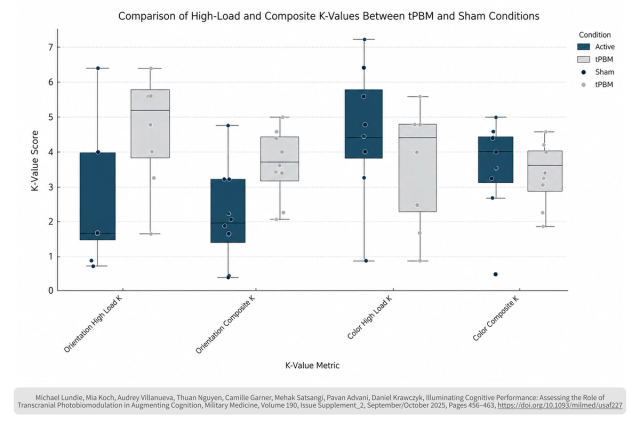
In high-load orientation trials, tPBM participants had significantly higher working memory capacity (K-values) than the sham group, suggesting better performance under cognitive load.
Pupillometry & Attention:
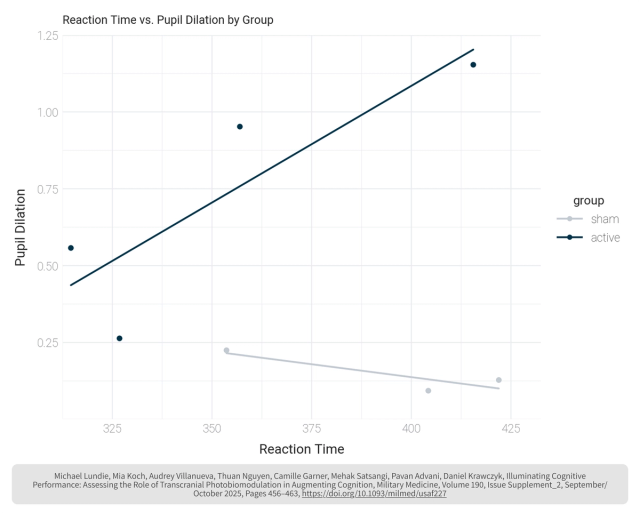
Participants receiving tPBM exhibited increased pupil dilation and greater consistency during tasks - physiological markers of heightened attentional engagement and potential involvement of neuromodulatory pathways (e.g., locus coeruleus-norepinephrine).
Psychological Metrics:
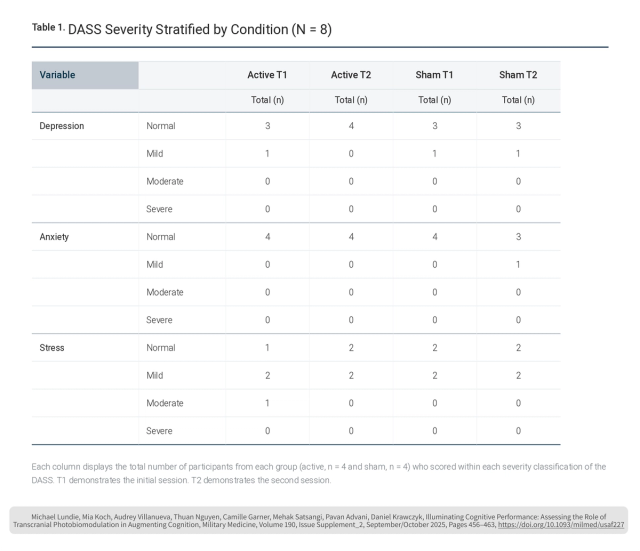
A majority of tPBM participants showed reductions in depression, anxiety, and stress scores, whereas sham controls did not show consistent improvements
FAQs
What results can be expected and when?
Types of results and their timelines vary depending on the individual. However, a combination of research and anecdotal evidence from providers suggests some expected results to be the following: improved language capabilities, improvements in emotional regulation, decreased repetitive behaviours, and improved social skills/engagement. While some clients may see results very quickly, others may take a few months.
What is mitochondrial dysfunction?
Mitochondrial dysfunction is a term that encapsulates dysfunction in various operations of the mitochondria. With mitochondria being the main energy producers of the cell, dysfunction can lead to reduced ATP (energy) production, increased oxidative stress, and difficulty maintaining healthy cell function. When mitochondria can’t keep up with the body’s energy demands or fail to remove damaged components, it can affect brain function, muscle strength, immune response, and overall vitality. Mitochondrial dysfunction is linked to many conditions, including fatigue, neurodegeneration, and metabolic disorders (Zong et al., 2024).
How many PBM sessions will I need?
Benefits can often be noticed within a few sessions, especially related to sleep and mental clarity. For cognitive improvements, consistent use over several weeks or months is typically recommended. Incorporating light therapy as a regular lifestyle habit can support overall brain health and give your brain the best chance to stay at its most performing level over time.
Is PBM safe?
Yes. PBM is FDA-cleared for various applications and has a strong safety profile. It’s non-invasive, painless, and has no known serious side effects when used as directed.
Learn More About PBM & Brain Health
 Blog
BlogMitochondrial Dysfunction: Causes, Symptoms, and How Light Can Help Restore Energy
Explore how PBM addresses mitochondrial dysfunction — restoring cellular energy, reducing oxidative stress, and supporting brain health

 Newsletters
The Most Overlooked Tool in Brain Injury Recovery and Biohacking
Discover why light therapy is becoming a key tool in brain injury recovery and biohacking—supporting energy, focus, and long-term resilience.

 Blog
BlogHow Brain Vital Signs and Photobiomodulation Are Shaping the Future of Brain Health
tPBM can rapidly improve cognitive processing, with cases showing up to 70 ms gains in healthy users, dramatic recovery post-concussion, and long-term benefits in mild impairment. Even advanced dementia patients show measurable brain activation changes.

References
American Brain Foundation. (n.d.). What is brain fog? https://www.americanbrainfoundation.org/what-is-brain-fog/
Bowen, R., & Arany, P. R. (2023). Use of either transcranial or whole-body photobiomodulation treatments improves COVID-19 brain fog. Journal of Biophotonics, 16(8), e202200391. https://doi.org/10.1002/jbio.202200391
Cleveland Clinic. (n.d.). Brain fog. https://my.clevelandclinic.org/health/symptoms/brain-fog
Denno, P., Zhao, S., Husain, M., & Hampshire, A. (2025). Defining brain fog across medical conditions. Trends in Neurosciences, 48(5), 330–348. https://doi.org/10.1016/j.tins.2025.01.003
Lundie, M., Koch, M., Villanueva, A., Nguyen, T., Garner, C., Satsangi, M., Advani, P., & Krawczyk, D. (2025). Illuminating cognitive performance: Assessing the role of transcranial photobiomodulation in augmenting cognition. Military Medicine, 190(Suppl. 2), 456–463. https://doi.org/10.1093/milmed/usaf227
Mehdizadeh, M., Farnam, A., & Nikzad, B. (2025). Transcranial photobiomodulation improves sleep quality, reduces daytime sleepiness, and modulates delta power in chronic insomnia: A randomized controlled trial. Lasers in Medical Science, 40(1), Article 451. https://doi.org/10.1007/s10103-025-04699-y