


Neuronic LIGHT vs. Vielight Neuro Gamma 4
Neuronic LIGHT ($1,795) covers the whole scalp with 300 LEDs, adjustable from 0 to 999 Hz and 0 to 100% intensity, with a 100% refund inside 90 nights. Vielight's Neuro Gamma 4 ($1,799) concentrates five high-power modules on fixed points at 40 Hz only, with more published studies, a 24-month warranty, and an 80% refund. Below: every spec, including the two areas where Vielight wins.
Which Light Therapy Device Should I Buy? The Short Version
These two devices are compared as they cost essentially the same. ($1,795 and $1,799), but they are built on opposite design philosophies.
Put simply: Vielight delivers a few powerful lights to less of your head, in one fixed way. Neuronic delivers 9 similarly powerful lights to more of your head, alongside 291 standard LEDs, at any pulse rate, intensity, and session length you choose.
The Neuro Gamma 4 is the current generation of Vielight's Neuro Gamma line (the previous model was the Neuro Gamma 3). Vielight also sells the Neuro Alpha (10 Hz), the Neuro Duo (both frequencies), and the larger Neuro Pro 2; this page compares the Neuro Gamma 4 because it is the model priced closest to the Neuronic LIGHT.
Two design philosophies
Neuronic LIGHT vs. Vielight Neuro Gamma 4: Coverage and Contol vs. Concentrated Intensity
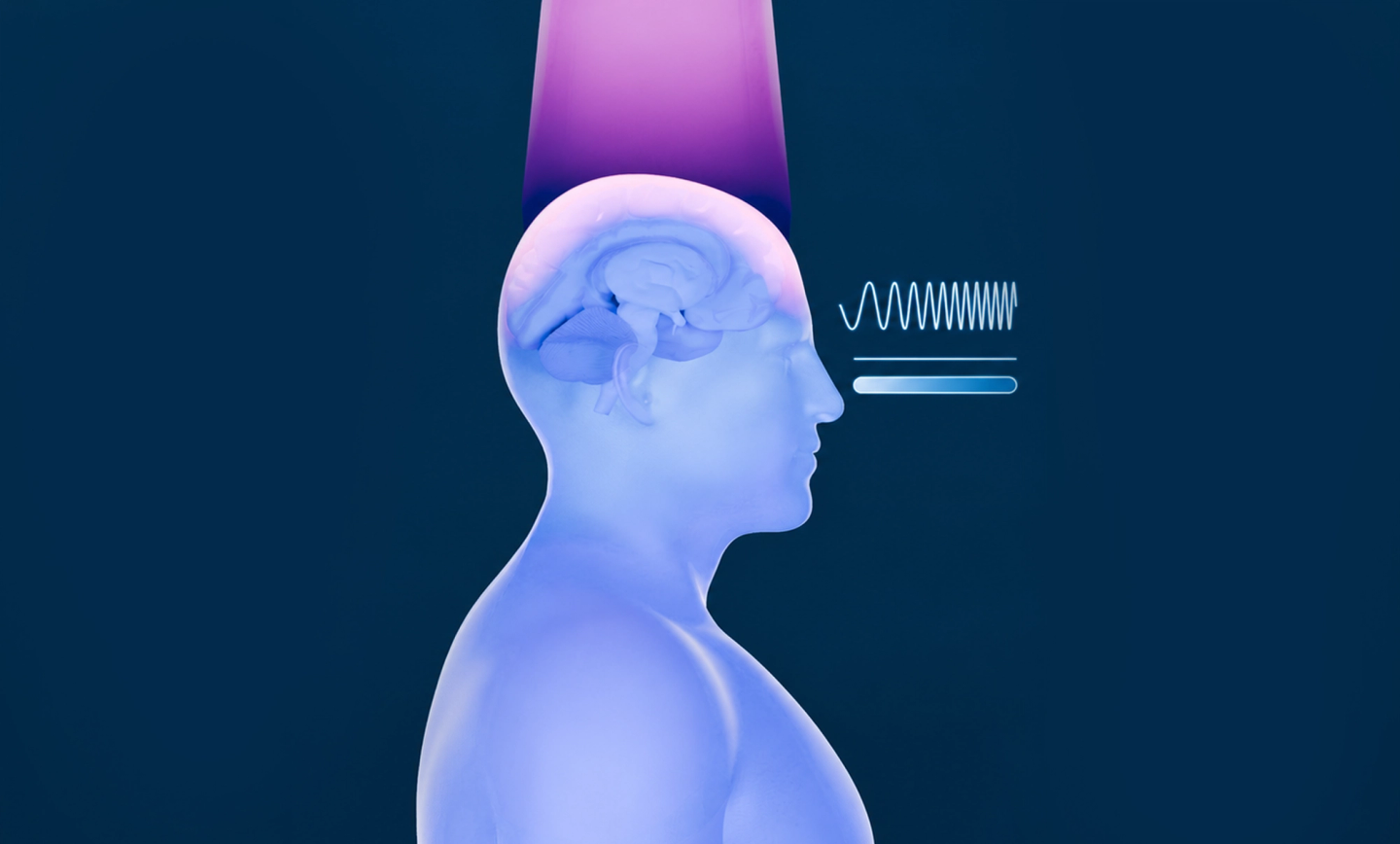
Neuronic LIGHT bets on intensity, coverage, and control
300 LEDs blanket the entire scalp with a total coverage of 670 cm², with every parameter under your control: any pulse frequency from 0 to 999 Hz, any intensity, any session length from 1 to 30 minutes. The 9 Ultra LEDs have an irradiance of 97 mW/cm², and total power output is 1,725 mW.
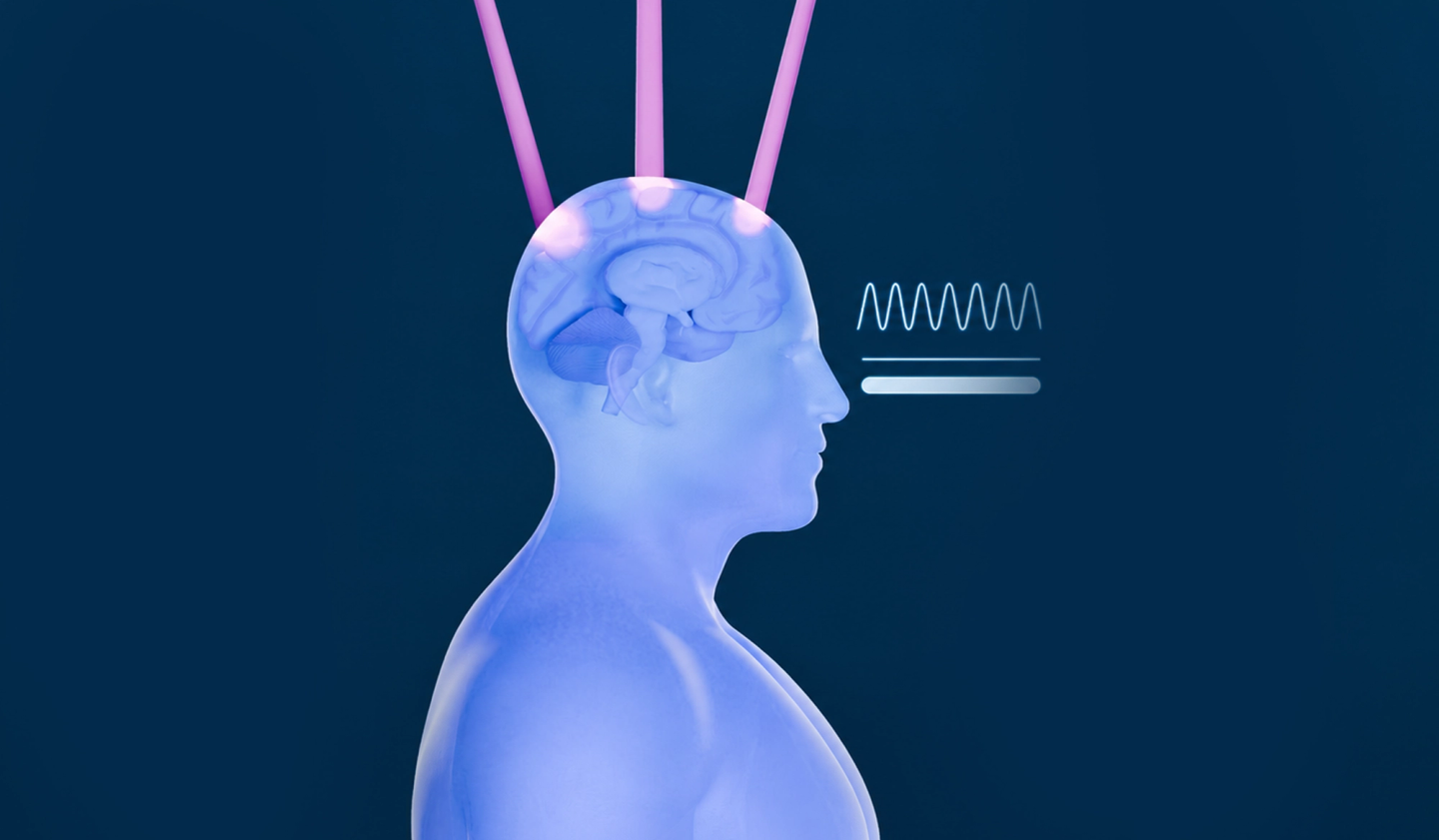
Vielight Neuro Gamma 4 bets on intensity
Five LED modules, four on the skull and one inside the nostril, fire a concentrated beam at specific sites over a coverage area of 5 cm². Output is locked to a single 40 Hz gamma rhythm. Vielight's self-declared specs list 75 to 100 mW/cm² for the transcranial LEDs, and only 25 to 50 mW/cm² for the intranasal LED.
Which Device Has Higher Irradiance?
After reviewing and testing both devices, our internal team found that Vielight's and Neuronic's outputs are measured differently. Using the same testing method on both, the main LEDs of each device report a similar irradiance of about 100 mW/cm²; however, it’s worth noting that some research papers show lower numbers for Vielight’s devices. Vielight also provides irradiance ranges vs. a specific number; for example, the intranasal is 25 - 50 mW/cm². Neuronic has published a 40 page report here on testing their devices, including a 1-hour presentation talking about the major takeaways.
What Should You Consider Before Buying a Light Therapy Device?
Once it is at home, will you use it daily? Is it easy enough that it becomes a habit, for you, for a parent, or for a child? The helmet-like structure is effortless: it sits on your head with no wires or frame to configure. Put it on like a hat, turn it on, and press the quick-start button so you can get on with your day. Compliance and regular use are two of the most important things when using light for anything; it is why we chose this form factor.
Specifications side by side
How the Neuronic LIGHT and the Vielight Neuro Gamma 4 compare
Every figure below is published by the manufacturer. Where the two companies measure things differently, that is noted rather than smoothed over. The highlight appears on both sides of the table. That is the point.
Stronger published figure
| Specification | Neuronic LIGHT $1,795 · 1070 nm · 300 LEDs | Vielight Neuro Gamma 4 $1,799 · 810 nm · 5 modules |
|---|---|---|
| Price (USD) | $1,795 (Stronger published figure) | $1,799 (Stronger published figure) |
| Wavelength | 1070 nm | 810 nm |
| Which wavelength is better is an open question; see the wavelength section below. | ||
| Light sources | 291 standard + 9 ultra-high-power LEDs (300 total) (Stronger published figure) | 5 LED modules (4 transcranial + 1 intranasal) |
| Coverage area | 670 cm² (full scalp plus cerebellum) (Stronger published figure) | ~5 cm² including the intranasal footprint |
| Irradiance | 97.08 mW/cm² per ultra-high-power LED (9 of them) · 1.53 mW/cm² per standard LED (291 of them) | 75 to 100 mW/cm² per head LED (4) · 25 to 50 mW/cm² intranasal (1) |
| Measured differently by each manufacturer, so the published figures are not directly comparable. Neuronic's internal testing, using one method on both devices, reports a similar irradiance of about 100 mW/cm² at the main LEDs of each. | ||
| Pulse frequency | 0–999 Hz, fully adjustable (Stronger published figure) | 40 Hz only (10 Hz requires purchasing another model, the Alpha model for another $1,799) |
| Intensity control | 0–100% adjustable (Stronger published figure) | Not user-adjustable |
| Session length | 1–30 min (presets 3–10 min) (Stronger published figure) | 20 min, fixed |
| Device app | Bluetooth app controls the device directly; stored user profiles (Stronger published figure) | None |
| Intranasal module | Not needed | Included as one of the five modules |
| Power | USB-C (wall adapter, or up to 120 min portable with a power bank) (Stronger published figure) | Rechargeable; charger included (Stronger published figure) |
| Warranty | 12 months (3-year Neuronic CARE available at extra cost) | 24 months (Stronger published figure) |
| Refund | 100%, within a 90-night trial (US, Canada, UK, Australia, EU) (Stronger published figure) | 80%, within 6 months of purchase |
| HSA/FSA eligible | Yes (Stronger published figure) | Yes (Stronger published figure) |
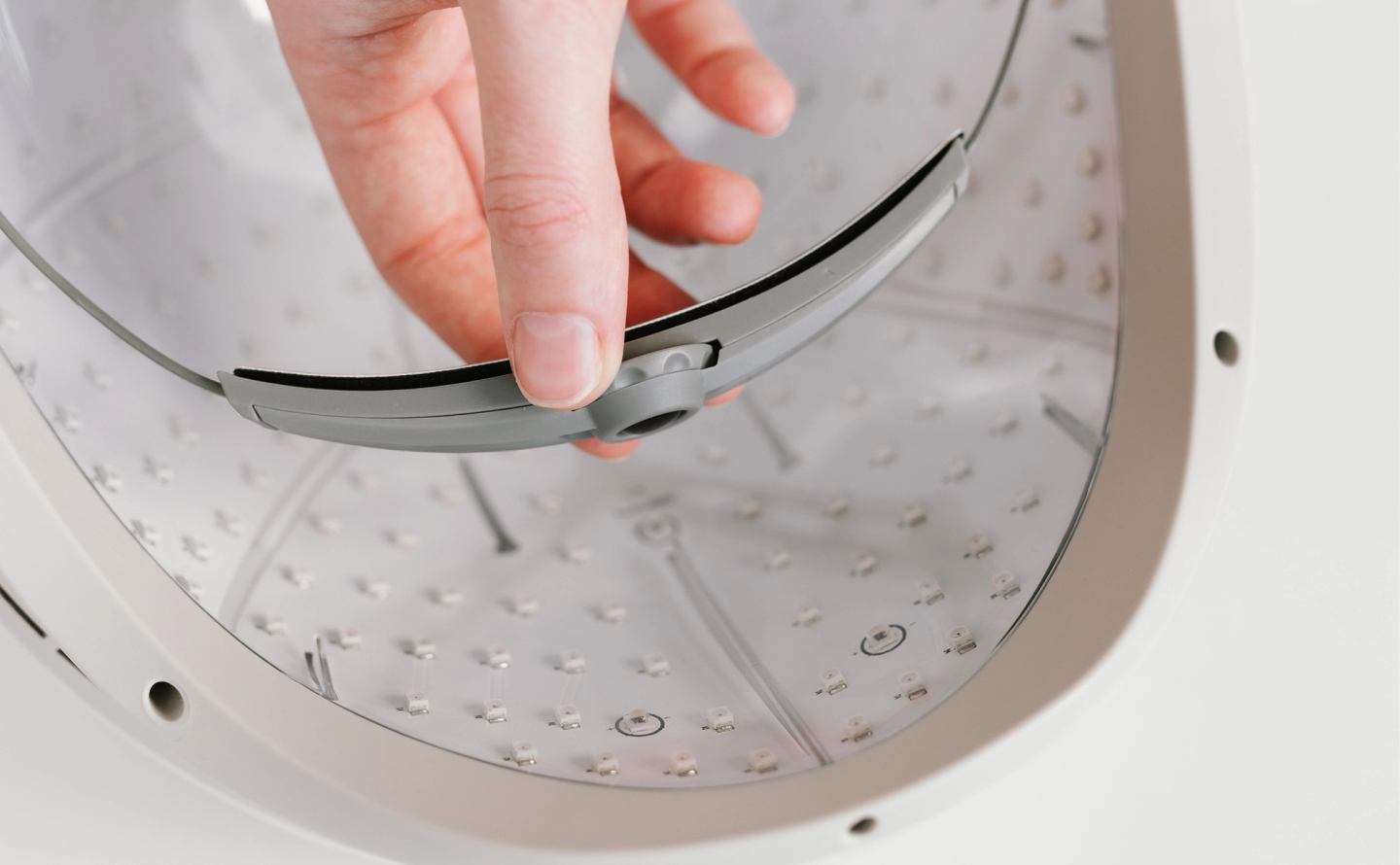
Where Does the Neuronic LIGHT Outperform the Vielight Neuro Gamma 4?
1. Neuronic covers the whole head; Vielight covers five spots
The Neuro Gamma places four modules on the skull. They are positioned to target the default mode network, and they are positioned well. But an LED illuminates the tissue beneath it, not the tissue between it and the next LED. Vielight's own published irradiance area is roughly 400 cm², and that figure includes the intranasal applicator's footprint, so the transcranial coverage alone is smaller still.
Neuronic LIGHT covers 670 cm²: the full scalp plus the cerebellum, which the Neuro Gamma does not reach at all. That is roughly 68% more area, with no gaps between emitters. If you do not already know which region of your brain you want targeted, coverage is the safer bet. If there is an area you want to target, illuminating other areas may still be a benefit.
2. More high-intensity emitters on the head
The Neuro Gamma's rear transcranial modules deliver 100 mW/cm², its frontal module 75 mW/cm², and the nasal applicator 25 to 50 mW/cm². Neuronic LIGHT's standard 291-LED array delivers 1.53 mW/cm², with 97.08 mW/cm² at its nine ultra-high-power LEDs.
The Neuro Gamma 4 concentrates its output on five sites. Neuronic's nine ultra-high-power LEDs are broadly comparable to a Vielight module in intensity, and there are nine of them against four transcranial modules on the Neuro Gamma. Whether a concentrated dose or a distributed dose produces better outcomes is genuinely unsettled in the literature, and anyone who tells you it is settled is selling you something.
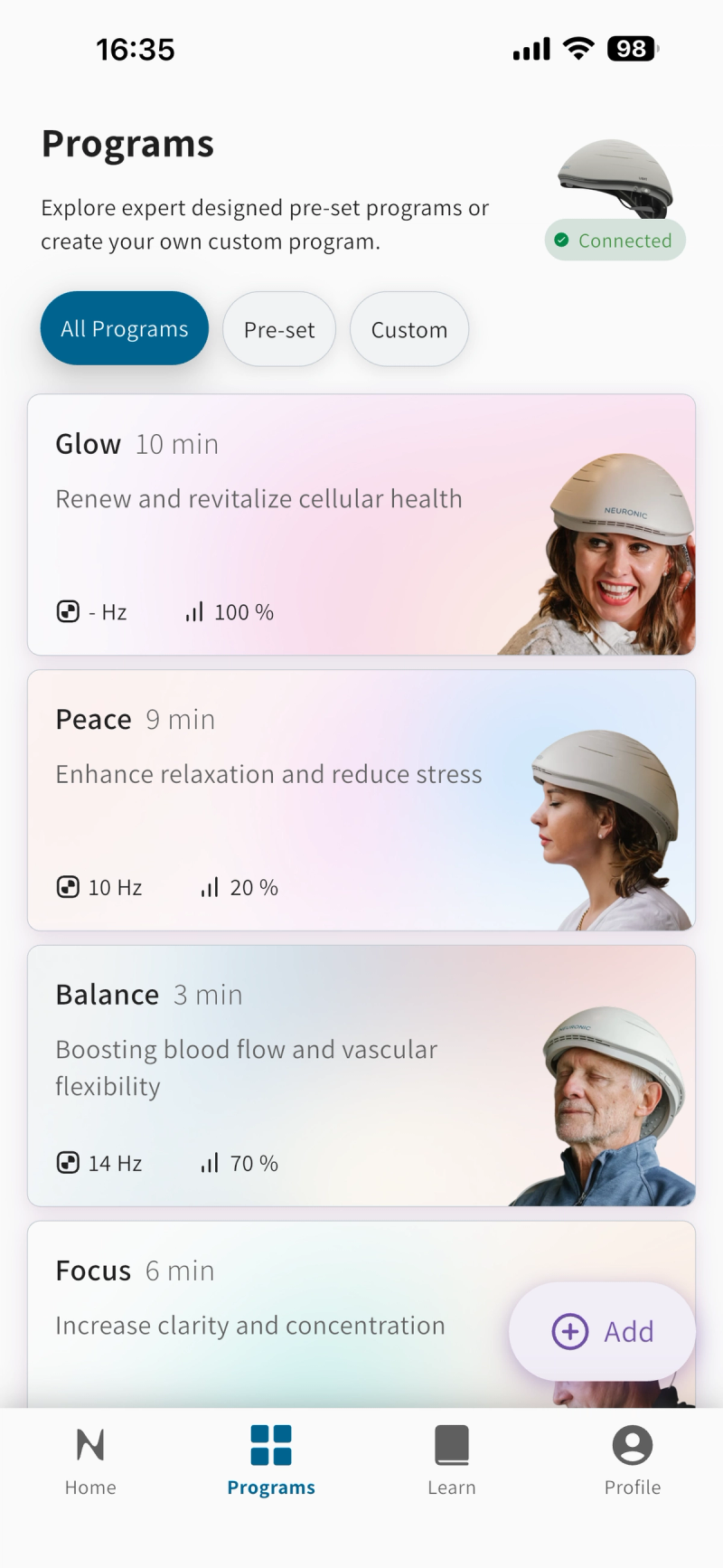
3. Neuronic LIGHT changes frequency without a second device
The Neuro Gamma is named for what it does: 40 Hz gamma. If you later want 10 Hz alpha, the rhythm associated with calm and relaxation, you cannot get it from this device. You buy the Neuro Alpha, or you buy the Neuro Duo, at an additional cost.
Neuronic LIGHT ships with four presets and a custom mode:
- Peace: 9 min, 20% intensity, 10 Hz
- Balance: 3 min, 70% intensity, 14 Hz
- Focus: 6 min, 50% intensity, 40 Hz, the same gamma rhythm the Neuro Gamma is built around
- Glow: 10 min, 100% intensity, continuous wave (no pulse)
- Custom: 1–30 min, 0–100% intensity, 0–999 Hz
The LIGHT does 40 Hz as one of its options. The Neuro Gamma does 40 Hz as its only option. Buying the more flexible device costs you four dollars less.
4. With Neuronic, you get 100% of your money back, not 80%
Photobiomodulation does not work identically for everyone, and no honest seller of either device will tell you otherwise. So the return policy is not fine print; it is the price of finding out. Having an extra three months does not help as much as getting all of your money back.
Refund policies compared
If the device is not for you
Better outcome for the buyer
| Specification | Neuronic LIGHT | Vielight Neuro Gamma 4 |
|---|---|---|
| Trial window | 90 nights | 6 months (Better outcome for the buyer) |
| Refunded | 100% (Better outcome for the buyer) | 80% |
| You get back | $1,795.00 (Better outcome for the buyer) | $1,439.20 |
| Return shipping | Free (US, Canada, UK, Australia, EU) | Handled via point of purchase |
Vielight gives you a longer window; Neuronic gives you all of your money. On a $1,799 device, the Neuro Gamma's 20% retention means trying it costs $359.80 whatever you decide. With the LIGHT, trying it costs nothing.
Two conditions you should know about
Orders paid through financing or installment plans (including Affirm) are not eligible for the refund. If the 100% guarantee is the reason you are buying, pay outright.
The refund applies to your first device only, and the device must come back in its original packaging with all accessories, in good condition. Bulk and research purchases are not eligible.
5. Sessions that fit your day
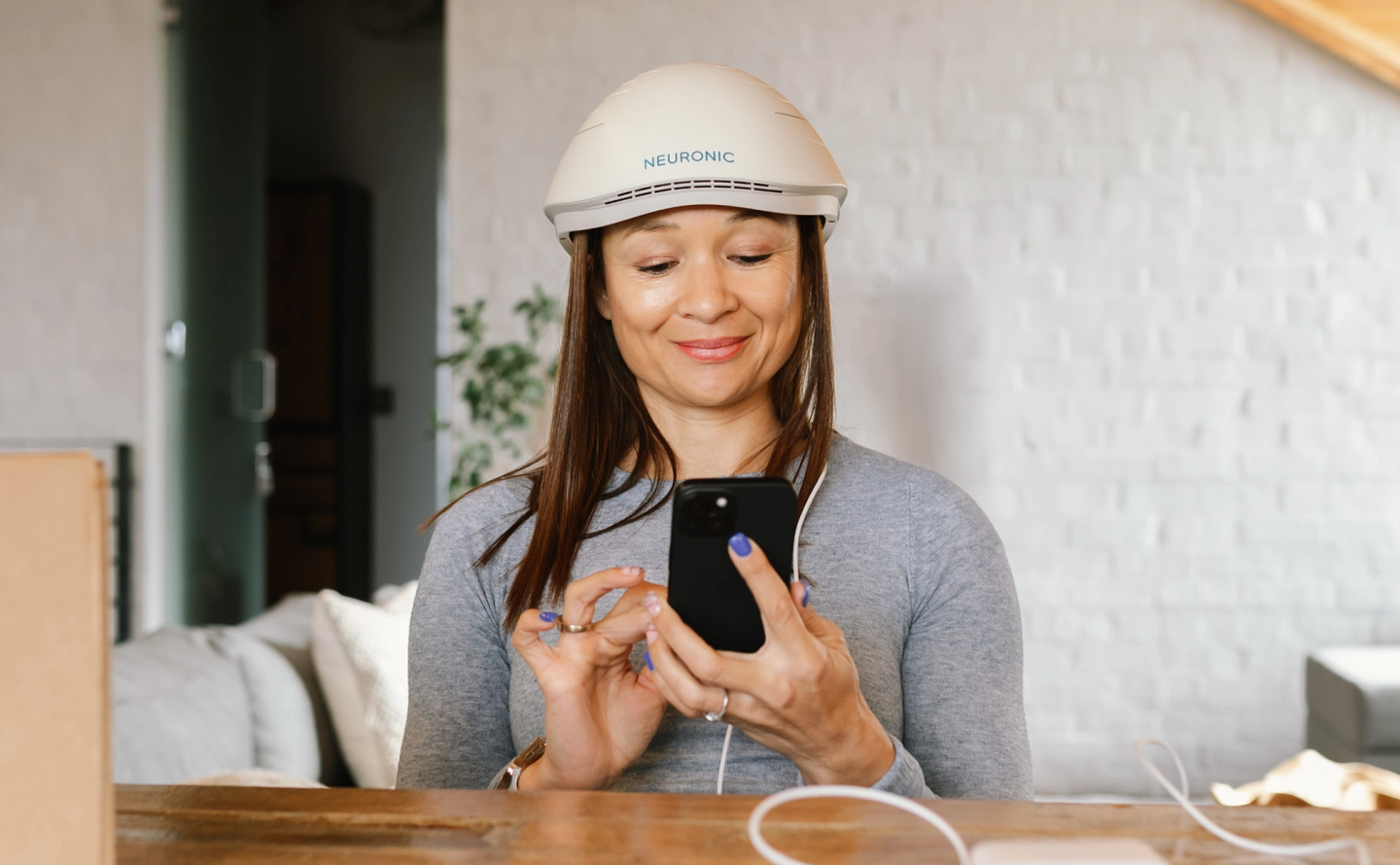
The Neuro Gamma runs a fixed 20-minute session. Neuronic LIGHT runs anywhere from 1 to 30 minutes, with typical use at 5–10 minutes twice daily. A three-minute Balance session before a meeting is something you can actually do; a three-minute Neuro Gamma session is not.
6. An app that controls the device
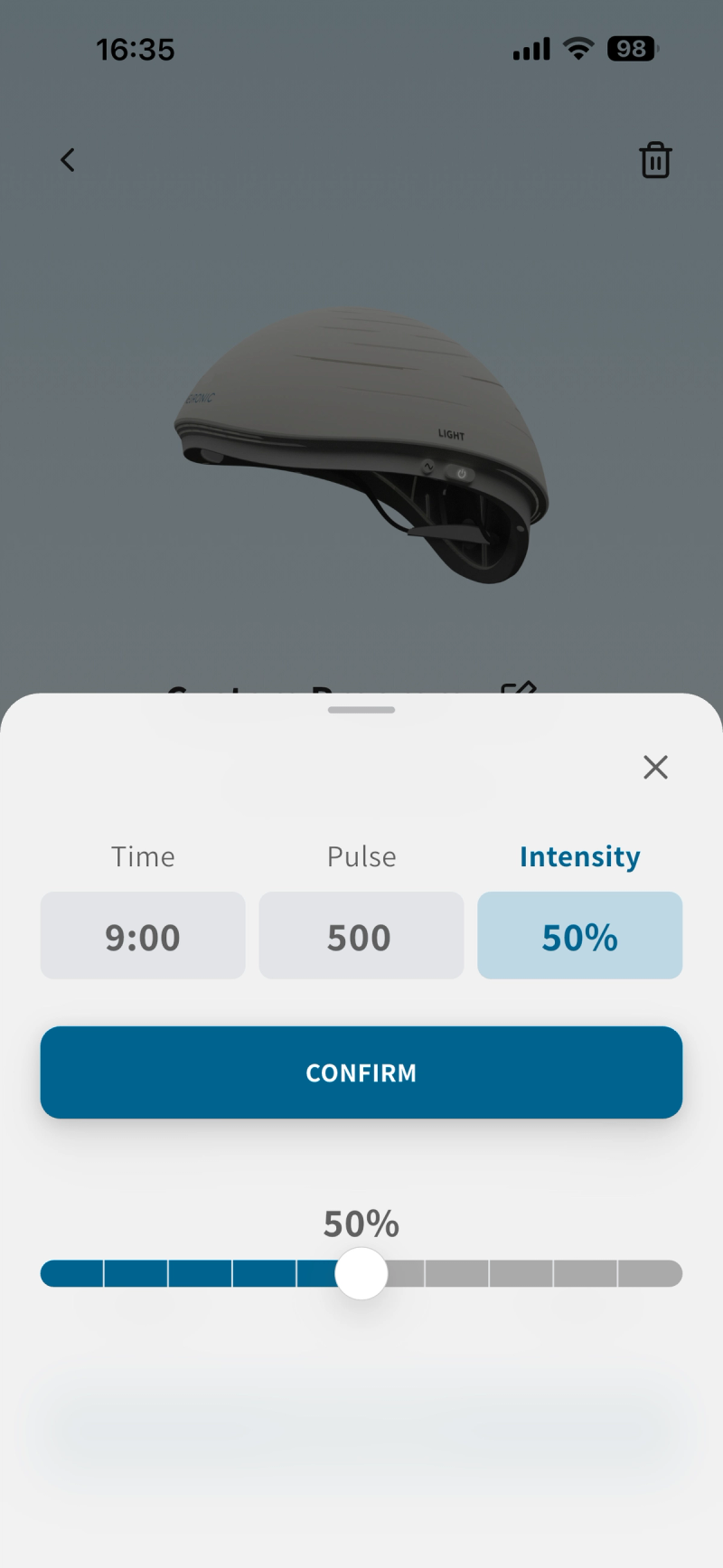
Both companies advertise software, and the two things are not comparable. Neuronic has a mobile app that pairs with the device: it starts sessions, builds custom protocols, adjusts intensity and frequency, and stores separate profiles so more than one person in a household can use the same helmet. It also shows usage history, shares data insights, and lets you learn more about light therapy. The helmet can also run a single program without the app, at the press of the quick-start button.
The Neuro Gamma 4 has no app; it is operated from the device itself. Vielight-AI, their separate EEG analysis product, requires its own hardware, is sold on a paid plan, and does not control the Gamma 4. Neuronic is a one-time purchase, and the app is included for life.
Where Does the Vielight Neuro Gamma 4 Outperform the Neuronic LIGHT?
A comparison that finds nothing good in the competitor is an advertisement. These are real advantages, and if any of these matters most to you, the Neuro Gamma is the device you should buy.
1. Published research
Vielight has been around since 2012, and its strongest card is that it cites 30+ published brain photobiomodulation studies. Devices emitting at 1070 nm have substantially fewer published studies behind them. Newer in the field does not mean less to uncover, and it is likely why Vielight is now funding research into 1064 to 1070 nm light too. Comparing high-quality studies only, there is an equal amount of research behind 1064 nm and the 800 nm range. That suggests 1064 nm may be the more promising direction, and that the field is moving toward it.
Neuronic's counterweight is real-world scale rather than trial volume: over 330,000 sessions delivered across the user base as of August 2026, with 6 published studies and counting. If a deep peer-reviewed literature is your primary decision factor, then as of today Vielight has more publications with its device.
The primary mechanism of action is the same for both, so more research on any photobiomodulation device strengthens the evidence base for the whole field.
2. A longer warranty period
Quite simply, the Vielight comes with a two-year warranty instead of Neuronic's one-year warranty. Clearly a winner on that front unless you purchase Neuronic's extended care plan.
Is 810 nm or 1070 nm Better for Brain Photobiomodulation?
Both companies publish articles arguing their wavelength is superior, and both arguments have holes.
Vielight's case for 810 nm: cytochrome c oxidase absorbs most strongly near 800 nm and falls off past 900 nm; a 2025 cadaver study found 810 nm transmitted about 2.2× more irradiance through an intact human skull than 1070 nm; Harvard Monte Carlo modeling favored 810 nm for energy deposition.
Neuronic's case for 1070 nm: the 1050–1100 nm range shows high transmission through biological tissue with minimal scattering, and 1070 nm has been associated with cognitive gains in human trials. Our published article does not, however, give penetration figures in millimeters, which is a fair criticism.
Our honest position: this is an open scientific question, not a settled one, and it should carry less weight in your decision than coverage, protocol control, and what you stand to lose if the device does not suit you. Do not buy either helmet because of a number in nanometers.
Our selection of 1070 nm was based on several studies, including work by Tyrell Pruitt in 2022 reporting that 1064–1070 nm penetrated further and produced a longer-sustained effect. This is not to say 810 nm is not effective: there is a large body of research on 810 nm because it was studied first, and real results are being obtained from both wavelengths.
Decision guide
Which Device Is Right for You?
Answer these honestly, and the choice makes itself.
Our recommendation
| What matters most to you | Neuronic LIGHT | Vielight Neuro Gamma 4 |
|---|---|---|
| You want the largest published research base and will not compromise on it | More studies on their technology (Our recommendation) | |
| You want more than one frequency at the same price | 0–999 Hz and 0–100% intensity versus one fixed 40 Hz setting (Our recommendation) | |
| You want an easy-to-use device and a habit you will stick to | A device in use beats any device on a shelf. A helmet is as easy as it gets: place it on, turn it on, press go. App reminders and session history help. (Our recommendation) | |
| You want whole-brain coverage, including the cerebellum | 670 cm² of continuous coverage versus five discrete modules over ~5 cm² (Our recommendation) | |
| Power is important | Roughly 100 mW/cm² per emitter in both devices, but 9 high-intensity LEDs on the head versus 4 (Our recommendation) | |
| You are unsure it will work for you and want a risk-free trial | 100% refunded versus 80%, a $359.80 difference in what a failed trial costs. (Our recommendation) | |
| You want an intranasal delivery route | Included with the Neuro Gamma 4; Neuronic LIGHT does not need one (Our recommendation) | |
| You want the longest included warranty | 24 months included versus 12. Neuronic offers extended coverage at additional cost. (Our recommendation) |
Summary
The decision is yours; the data is above. Light therapy is a growing industry.
Vielight's products are good; they have a lot of research behind them, and the company has been around since 2012. Power outputs, wavelengths, and protocols all need further research, which is why neither company has FDA clearance for a specific condition; both are wellness devices.
Neuronic has done its research, invested heavily in independent testing, and focuses on turning the data into a strong user experience.
Try light with either company. The biggest regret is not trying at all.

Neuronic LIGHT
$1,795excl. sales tax
At-home near-infrared brain stimulation designed to support clarity, focus, and long-term cognitive wellness.
- 90-Day Return Policy
- Backed by Research
- Free Shipping
- One Year Warranty
Frequently asked questions
Is the Neuronic LIGHT better than the Vielight Neuro Gamma 4?
It depends on what you value. Neuronic LIGHT wins on coverage (670 cm² vs. ~400 cm²), the number of high-intensity emitters on the head (9 vs. 4), protocol control (0–999 Hz and 0–100% intensity vs. a fixed 40 Hz), session flexibility (1–30 min vs. a fixed 20 min), the app, and the refund (100% vs. 80%). The Neuro Gamma 4 wins on published research (30+ studies) and included warranty (24 months vs. 12).
What is the price difference between the Neuronic LIGHT and the Vielight Neuro Gamma 4?
$4. The Neuronic LIGHT is $1,795 and the Vielight Neuro Gamma 4 is $1,799 (USD, manufacturers' published prices as of August 31, 2026).
Does the Neuronic LIGHT do 40 Hz gamma like the Vielight Neuro Gamma?
Yes. The Focus preset runs at 40 Hz, and custom mode covers any frequency from 0 to 999 Hz, including 10 Hz alpha. The Neuro Gamma 4 runs 40 Hz only; 10 Hz requires the separate Neuro Alpha or Neuro Duo.
Which wavelength is better, 810 nm or 1070 nm?
This is an open scientific question. Vielight cites stronger absorption by cytochrome c oxidase near 800 nm and a 2025 cadaver study showing higher skull transmission at 810 nm; Neuronic cites high tissue transmission in the 1050–1100 nm range and cognitive gains at 1070 nm in human trials. We recommend weighing coverage, protocol control, and refund terms more heavily than the wavelength.
What happens if the device does not work for me?
Neuronic refunds 100% within a 90-night trial (US, CA, UK, AU, EU) with free return shipping; orders paid through financing or installment plans are not eligible, and the refund applies to your first device only. Vielight refunds 80% within 6 months of purchase, so trying a $1,799 Neuro Gamma 4 costs $359.80 if you return it.
Are the Neuronic LIGHT and Vielight Neuro Gamma 4 HSA/FSA eligible?
Yes. Both devices are HSA/FSA eligible according to each manufacturer.
Is either device FDA approved?
No. Both are general wellness devices. Neither has FDA clearance for a specific condition, and neither is intended to diagnose, treat, cure, or prevent any disease.
Sources
Every specification, price, and policy term on this page comes from the manufacturers' own published pages, accessed August 31, 2026.
- Vielight Neuro Gamma 4 product page
- Vielight refund and warranty policy
- Vielight, "810 nm vs. 1070 nm for Brain PBM"
- Neuronic LIGHT product page
- Neuronic refund policy
- Neuronic, "What is the Difference Between 1070 nm vs 810 nm Wavelengths?"
- Neuronic research page
- Vielight Published Study
Important. Both the Neuronic LIGHT and the Vielight Neuro Gamma 4 are general wellness devices. Neither is intended to diagnose, treat, cure, or prevent any disease or medical condition. Photobiomodulation is not a substitute for medical care, and individual responses vary. Contraindications for the Neuronic LIGHT include pregnancy, metal implants in the head, a history of seizures, and certain thyroid conditions. Speak with a qualified medical professional before beginning use, particularly if you have an existing condition or take photosensitizing medication.
This comparison was prepared by Neuronic. We have tried to state our competitor's advantages as plainly as our own, and every figure is cited so you can check it. Where the science is unsettled, we have said so rather than claimed a winner.